
AR VR Game Development Services In California
You’re here because something’s not working. Either your game concept is stuck in development limbo, your tech stack can’t handle VR frame rates, or you’re tired of getting the runaround from teams who say “yes” but deliver “maybe.”
We’ve worked with UK-based developers, brand managers, and startup founders who tried hiring so-called AR/VR experts in California, only to find out later their “team” was three freelancers in different time zones passing files on Slack.
You’re building an AR or VR game because you want it played, downloaded, and talked about. And not in 18 months.
Pearl Lemon Games handles that. And we do it with people who know the job.
What Our AR VR Game Development Services In California Cover
There’s a lot that can go wrong in AR and VR game development. Poor frame pacing. Bad tracking. UI glitches that only show up in the headset. Clunky network code. We’ve seen it all—and built around it.
Below are eight services built around solving the kind of issues you’re likely dealing with right now.
Full-Cycle AR And VR Game Production
- Hardware compatibility (Oculus Quest, Vive, PSVR, WebXR)
- Engine choice and setup (Unity, Unreal Engine, Godot)
- Asset pipelines and scene optimisation
- Performance budgets for mobile AR and room-scale VR
AR Game Development For Retail, Events And Mobile
AR’s biggest problem? Too many apps that feel like toys, not tools. We fix that by designing with user interaction metrics in mind—tap response latency under 150ms, gesture inputs under 10° drift, and stable tracking in mixed lighting environments.
We develop:
- Marker-based and markerless AR
- Face and body tracking overlays
- Retail product visualisers
- Location-based AR event apps
We build primarily for Android and iOS using ARKit, ARCore, and WebAR integrations.
VR Game Development For PC And Mobile
- First-person and third-person player controls
- 6DoF input systems
- Object interaction systems
- Haptic and audio feedback for immersion without dizziness
Multiplayer VR Architecture And Sync Systems
If your VR game involves more than one player, latency is your enemy. We design multiplayer systems with netcode that compensates for packet loss, jitter, and rubberbanding.
Using Photon, Normcore, or custom WebRTC setups, we deliver:
- Avatar syncs with sub-100ms interpolation
- Room-based and peer-to-peer architectures
- Voice chat integration
- Server-side anti-cheat systems
We’ll help you scale from 2 to 100 concurrent users without compromising responsiveness.
Augmented Reality Integration For Existing Mobile Games
We work with your source code Unity, Flutter, native Android/iOS and inject:
- Scene tracking
- Object placement
- Camera control layers
- Cross-device compatibility testing
VR Simulation For Training And Education
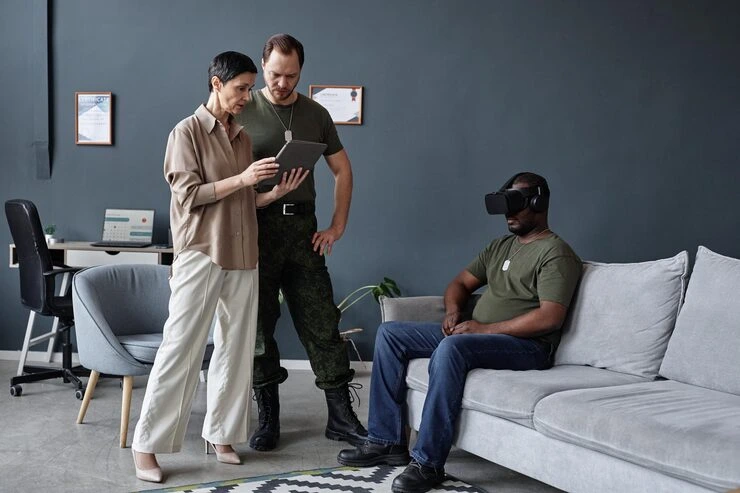
We’ve built VR apps for simulation-based training in fields like medical, engineering, and warehouse logistics. These require exact physics, 1:1 hand interactions, and frictionless onboarding for users not used to gaming controls.
We specialise in:
- Physics-accurate interaction design
- Voice-guided tutorials and scenario flows
- Real-time analytics capture for user feedback
- Integration with SCORM, xAPI, or proprietary LMS platforms
This isn’t “cool tech.” It’s functional software with a purpose.
AR Game UX And UI Design For High Retention
If players can’t find the tap zone or lose their anchor point in AR, they won’t stick around. Our UI/UX is designed to solve actual problems—like occlusion clashes, poor gesture recognition, and misaligned object layers.
We test with:
- Eye-tracking diagnostics
- Low-vision and dyslexia filters
- One-handed control paradigms for AR
- Voice command fallbacks
We’ll show you test heatmaps that highlight user behaviour, not just pretty interfaces.
QA And Bug Fixing For Headset-Specific Issues
Most bugs don’t show up in builds. They show up in the headset. We test on-device with motion simulators, refresh-rate throttling, and field of view clipping to catch the issues before your users do.
We do:
- Regression testing across firmware versions
- SDK versioning for ARKit/ARCore
- Controller compatibility matrices
- Framerate drop triggers under system load
No one wants their 4.9-star app dropping to 3.2 after a firmware update.

Why Choose Us
We’re a UK-based team working closely with developers and studios across California. We know the timezone difference works in your favour—because we ship updates overnight while you sleep.
You’ll deal with actual developers. No account managers. No vague promises. You’ll see working builds, frame counts, dev logs, and unit-tested code. We build for people who want results, not “brand presence.”
Schedule your consultation now. We’ll map out what’s possible, what’s broken, and what can get delivered.
Frequently Asked Questions
Primarily Unity and Unreal Engine. For smaller mobile AR projects, we may use Godot or custom frameworks depending on performance requirements.
Yes. We build for PC, mobile, and console in parallel, using abstraction layers to support deployment across multiple platforms without duplicated work.
We use predictive movement and input smoothing, along with physics time-step adjustments, to reduce perceived latency to under 20ms for most systems.
Absolutely. We guide you through compliance, packaging, SDK versions, and the submission process to meet the requirements for each platform.
Device testing, motion testing, memory leak tracking, frame-pacing analysis, crash logs, and platform SDK integration checks.
Let’s Talk About Getting Your AR VR Game Built Properly
Stop wasting time with agencies that only talk about “immersive experiences.” Let’s talk about shipping something that works, installs cleanly, and keeps users coming back.
Schedule your consultation now. We’ll map out what’s possible, what’s broken, and what can get delivered.
No hard sell. No sales pitch. Just answers.
