
AR VR Game Development Services In North Carolina
You’ve got a concept. Maybe it’s sketched on a napkin. Maybe it’s a 30-slide pitch deck. Either way, you need more than a coder-for-hire. You need people who’ve shipped interactive projects, not just talked about them.
Whether you’re a funded startup in Charlotte or a tech team in Raleigh that’s hit a wall with dev resources, this is where it starts to get serious. No fluff. Just clear direction, technical capability, and support you can rely on.
Schedule a consultation now – get clarity on your next move, not a sales pitch.
Our Services
You don’t need everything. You need the right thing. Below are eight specific services built for the kind of teams Pearl Lemon Games works with—agencies, indie studios, enterprise brands, and developers stuck mid-project—across North Carolina and the UK.
Each one is here to fix a common pain, not pad the invoice.
Full-Stack AR/VR Game Development
If you’re starting with a raw concept, this service handles the entire build, from gameplay mechanics to deployment. We work with Unity and Unreal Engine, delivering fully interactive environments optimised for Meta Quest, HTC Vive, iOS ARKit, and Android ARCore.
We handle scene management, occlusion culling, shader optimisation, and frame budgeting to ensure stable frame rates (90+ FPS on headset devices), especially critical in reducing VR-induced nausea.
Whether it’s multiplayer VR shooters or AR educational simulations, we’ve delivered stable releases for all major platforms. Our networked game architecture includes Photon, Mirror, and custom socket programming when required.
AR-Based Mobile Game Development
If you’re targeting AR-first audiences on iOS or Android, we integrate directly with ARKit and ARCore SDKs to ensure device-level precision in plane detection, lighting estimation, and environmental tracking.
We build object occlusion using LiDAR-supported models and deploy persistent AR anchors so that gameplay can be resumed or shared across sessions, key for gamified education or retail AR.
From AR scavenger hunts for schools in Durham to location-based mobile activations in Greensboro, our builds come with load-tested architecture to support high concurrency without server drops.
VR Game Mechanics and UX Engineering
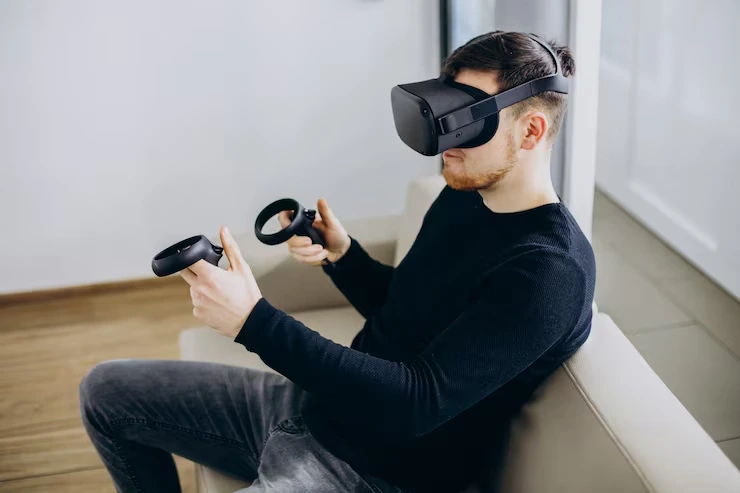
VR users have different expectations. They don’t click—they gesture. They don’t scroll—they walk or teleport. That’s why input mapping is critical.
We design mechanics around natural motion: inverse kinematics, gesture recognition, haptics integration, and spatial audio mapping. These are not “features”—they’re necessities.
We build native UX logic for VR interfaces that factor in player ergonomics, gaze targeting, and radial UI. Our team has shipped content with Oculus Interaction SDK, SteamVR Input System, and custom XR toolkits.
Multiplayer VR/AR Development
If your project involves real-time player interaction, latency management becomes mission-critical. We use Photon Fusion, Normcore, and dedicated server instances via AWS Gamelift and Azure PlayFab to keep lag under 100ms, even with cross-region traffic.
We’ve built multiplayer rooms with in-world chat, gesture-based interaction, and persistent character data synced to the cloud.
Whether you’re building a co-op escape room in virtual space or an AR board game with peer-to-peer logic, we don’t just “add” multiplayer—we engineer it from the foundation up.

3D Modelling And Environment Design
From low-poly mobile-friendly assets to ultra-detailed photorealistic environments, we use Blender, Maya, and Substance Painter to produce assets optimised for in-game performance and memory constraints.
Every asset goes through polycount analysis, lightmap baking, and compression testing to ensure optimal GPU load. Need 4K textures that won’t spike your RAM? That’s what we do.
We also handle Level of Detail (LOD) creation to keep draw calls down and maintain consistent framerates on both mobile and headset platforms.
Mixed Reality Game Integration
We support MR development using Meta Presence Platform and Microsoft’s MRTK (Mixed Reality Toolkit), allowing for smooth real-world overlays and occlusion-aware experiences.
Perfect for clients working in education, training simulations, or on-site activations where digital content must respond to physical space.
MR environments require careful calibration of anchor mapping, collision layers, and real-world geometry scanning—areas we’ve battle-tested across five industry projects last year.
Technical Consultation and Code Audit
Not sure why your app is jittering every time the user turns? Getting device-specific crashes? We provide code-level audits and full reviews of your Unity/Unreal project architecture.
We’ll flag issues with mesh colliders, memory leaks, thread mismanagement, and poor frame capping. Our team has rescued half-built projects from previous vendors and pushed them across the finish line with stability.
Whether it’s a haptic bug or AR image tracking failing under low light, we’ll isolate the issue and give you a clear recovery plan.
Post-Launch Maintenance And Patch Support
We don’t vanish after hand-off. We provide versioned patch cycles, hotfix deployment, crash log monitoring, and analytics dashboards. You’ll know what your users are doing in the app, what they’re clicking, and where they drop off.
We track retention, hardware compatibility, and session length because retention is where the value sits.
Our post-launch packages include regression testing, SDK updates, and backwards compatibility testing with older OS versions.
Schedule a consultation now – get clarity on your next move, not a sales pitch.

Why Choose Us
We’re not here to win awards. We’re here to ship games that don’t fall apart under pressure. Our team includes AR/VR developers who’ve worked on headset-exclusive titles, former QA leads who know what breaks builds, and designers who test on-device, not just in simulators.
Most importantly, we treat your project like it’s ours. Because once your name is on it, ours is too.
Schedule a consultation now – get clarity on your next move, not a sales pitch.
Frequently Asked Questions
We build with Unity and Unreal Engine, depending on project scope. Unity works well for mobile AR and cross-platform VR. Unreal is preferred for ultra-realistic VR experiences or PC-connected headsets.
We target 90 FPS minimum on headsets like Meta Quest 2 and HTC Vive. For mobile-based AR, we target 60 FPS to avoid battery drain and overheating.
Yes, using tools like 8thWall, A-Frame, and Babylon.js. However, there are hardware limitations and lower fidelity compared to native app builds.
We test across multiple devices with varying camera specs, lighting conditions, and OS versions. We simulate low light and overexposed environments to see how tracking holds.
Yes. We implement spatial voice, gesture-to-chat logic, and cross-device communication using Photon Voice and custom socket layers.
Ready To Stop Guessing And Start Building?
You’ve seen what we do. You’ve seen how we work. Now it’s your move.
The next step is simple. If you’re serious about launching, scaling, or rescuing an AR/VR game, book your consultation today. Not a pitch. Not a funnel. Just straight answers on what it’ll take to get your project off the ground or back on track.
Schedule your consultation now and let’s talk. No pressure. Just progress.
