If you are searching for a video game development company, chances are you are already weighing two very different types of studios.
On one side, you have Virtuos, a global giant trusted by AAA publishers for large-scale production, co-development, and art pipelines. On the other hand, Pearl Lemon Games is a London-born studio built for speed, experimentation, and close collaboration with founders, indie studios, and growing publishers.
This comparison exists because buyers keep asking the same question.
Do you go with scale and process, or proximity and pace?
Pearl Lemon Games operates as part of the wider Pearl Lemon Group, known in the UK for hands-on leadership, short feedback loops, and execution that moves without layers of approval. Virtuos operates at a very different altitude, supporting some of the biggest franchises in the industry with deep benches and long-term production cycles.
Both can build games.
Both can support development pipelines.
Only one will feel like an extension of your internal team from week one.
In this guide, we break down how each video game development company operates, who they are best suited for, and where the real trade-offs sit, especially for UK-based studios deciding where to place their budget and trust.
Quick In-Depth Comparison Table
Before getting lost in promises and pitch decks, this table gives you a straight snapshot. It shows how Pearl Lemon Games and Virtuos line up as a video game development company, without opinion layered on top. This is the quick scan most buyers wish they had first.
Pearl Lemon Games vs Virtuos Comparison
| Category | Pearl Lemon Games | Virtuos |
| Company type | Independent game development studio | Global AAA development group |
| Founding roots | London, UK | Singapore with global expansion |
| UK presence | Strong UK identity and leadership | UK offices as part of a global network |
| Primary focus | Game development and co-creation | Large-scale co-development and production |
| Typical client size | Indie studios, funded startups, mid-sized publishers | AAA publishers and major studios |
| Project size | Small to mid-scope titles | Large multi-year productions |
| Entry cost | Lower barrier to start | High minimum engagement |
| Contract flexibility | Shorter commitments possible | Long-term contracts preferred |
| Onboarding speed | Fast start after the agreement | Slower due to approvals |
| Decision makers | Direct access to leadership | Layered management structure |
| Communication style | Frequent and direct | Formal and process-led |
| Time zone alignment for the UK | Fully aligned | Partially aligned |
| Development model | Collaborative, hands-on | Pipeline-based production |
| Custom gameplay systems | Yes | Yes |
| Full game builds | Yes | Yes |
| Co-development support | Yes | Core strength |
| Art and animation | In-house and partner supported | Large specialised teams |
| Technical art | Available on demand | Dedicated departments |
| Engine support | Unity, Unreal | Unity, Unreal, proprietary tools |
| Platform coverage | PC, console, mobile | PC, console, mobile |
| Live service support | Available for select projects | Strong capability |
| QA integration | Integrated during development | Separate QA pipelines |
| Tooling approach | Practical and lightweight | Enterprise-grade systems |
| Reporting cadence | Frequent and informal | Structured and scheduled |
| Iteration cycles | Short feedback loops | Longer review cycles |
| Founder involvement | Active and visible | Executive level only |
| Team structure | Small focused squads | Large distributed teams |
| Talent model | Core team plus specialists | Thousands across studios |
| Scalability | Limited by design | Very high |
| Creative input | Encouraged from client | Usually defined upfront |
| IP sensitivity | Comfortable with early-stage IP | Best for established IP |
| Risk tolerance | Higher | Lower |
| Procurement process | Simple | Formal vendor approval |
| Legal complexity | Low | High |
| NDA and compliance | Standard | Extensive |
| Cultural feel | Startup-oriented | Enterprise-oriented |
| Best fit | Teams wanting speed and closeness | Teams needing scale and volume |
| Video game development company positioning | Flexible UK studio | Global production powerhouse |
Pearl Lemon Games
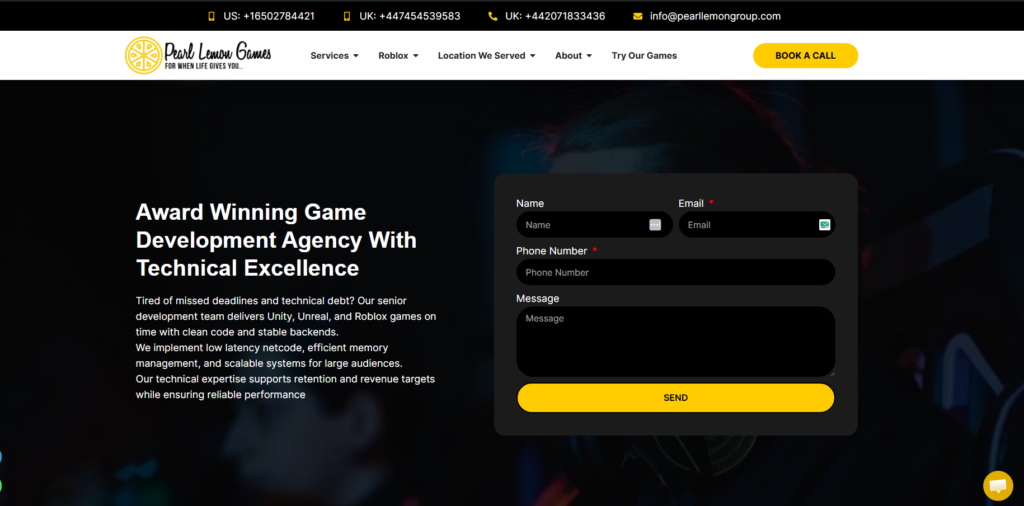
Pearl Lemon Games is not trying to look like a giant studio. That is deliberate. It operates as a focused video game development company built around speed, access, and tight collaboration. If Virtuos feels like plugging into an industrial pipeline, Pearl Lemon Games feels like sitting at the same table.
Company Background and Origins
Pearl Lemon Games was formed under the Pearl Lemon Group, a London-founded organisation known for building specialist teams that move quickly and stay close to clients. The group was started by Deepak Shukla in 2016 and expanded into gaming as demand grew from founders and studios who wanted development without the friction of enterprise studios.
This is not a legacy studio with decades of hierarchy. It is a younger operation shaped by shipping, testing, reviewing, and adjusting without ceremony.
That matters if you are building something new rather than maintaining something already massive.
What Pearl Lemon Games Actually Builds
Pearl Lemon Games works across full-cycle development and co-development. That includes gameplay systems, mechanics, UI, multiplayer logic, and platform builds depending on scope.
The studio is comfortable stepping in early, when ideas are still rough, and working alongside founders who want discussion rather than handoffs.
This makes them a better fit for projects that are still taking shape rather than titles locked into rigid production plans.
Engines and Technical Stack
The team works primarily with Unity and Unreal. The approach is practical rather than tool heavy. The focus is on getting playable builds in front of decision makers fast.
There is less obsession with internal frameworks and more attention on what actually runs and feels right in the player’s hands.
If you want reports polished for procurement teams, this may feel informal. If you want to see progress in builds, this works in your favour.
Onboarding and First Thirty Days
Pearl Lemon Games tends to start quickly. Once the scope is agreed, development begins without weeks of internal approvals.
Clients deal directly with the people building the game. That reduces translation errors and shortens feedback cycles.
For UK studios, time zone alignment removes the delays that come with overseas teams working out of sync.
Communication and Working Style
Communication is frequent and plain spoken. You are not filtered through account layers. Questions are answered by developers, not relayed through managers.
This can feel intense for teams used to formal distance. For others, it is exactly what keeps projects from drifting.
Pricing Structure and Flexibility
Pearl Lemon Games generally operates with lower entry costs than large global studios. Engagements can start smaller and scale if the project proves itself.
This reduces risk for early-stage studios and funded startups testing ideas before committing large budgets.
There is less appetite for long, locked-in contracts and more openness to phased delivery.
Creative Input and Collaboration
Clients are expected to have opinions. Creative back and forth is part of the process, not something reserved for early workshops.
This suits teams who want to shape the game as it develops, not simply receive assets against a fixed brief.
Ideal Client Profile
Pearl Lemon Games is best suited to:
- Indie studios with funding
- Founders building a first or second title
- UK teams want close collaboration.
- Publishers testing new IP
- Teams frustrated by slow vendor response
It is not designed for massive multi-year AAA production at a global scale.
That is not a weakness. It is positioning.
Virtuos

Virtuos sits at the opposite end of the spectrum from a boutique video game development company. It is built for volume, repeatability, and scale. If Pearl Lemon Games is about closeness, Virtuos is about reach.
This is a studio designed to plug into massive production plans without slowing them down.
Company Background and Scale
Virtuos was founded in Singapore and has grown into one of the largest game development service providers in the world. It operates dozens of studios across Asia, Europe, and North America, supporting many of the most recognisable franchises in modern gaming.
This is not a studio built around a single leader or a tight core team. It is a system of studios, departments, and pipelines designed to handle constant throughput.
That scale is its main strength.
What Virtuos Is Known For
Virtuos is best known for co-development, remasters, ports, art production, and systems support on AAA titles. Many publishers rely on Virtuos to extend internal teams rather than replace them.
The work is often deeply specialised. One team may handle environment art. Another may focus on optimisation. Another may manage a specific platform port.
If you already have a clear production plan, Virtuos can slot into it with minimal disruption.
Production Model and Pipelines
Virtuos operates with structured pipelines and formal review processes. Tasks are scoped precisely. Milestones are defined early. Changes move through approval paths.
This reduces risk on large projects but adds friction when ideas are still fluid.
For teams that want constant revision and creative back and forth, this model can feel restrictive. For publishers managing hundreds of contributors, it is necessary.
Engines and Technical Capabilities
Virtuos supports all major engines, including Unity and Unreal, alongside proprietary systems used by large publishers. Technical depth is one of its calling cards.
There are dedicated departments for engine work, technical art, performance optimisation, and platform compliance.
This makes Virtuos well suited for demanding technical requirements and legacy systems.
Onboarding and Procurement
Engaging Virtuos is rarely quick. Vendor approval, legal checks, security reviews, and internal alignment are part of the process.
Once inside, execution is consistent. Getting there takes time.
For studios working under tight deadlines or limited funding windows, this can be a blocker.
Communication and Client Access
Communication is professional and structured. Clients usually interface with producers or account managers rather than individual contributors.
This creates clarity but distance.
Direct access to senior leadership or hands-on developers is not the norm, especially on smaller scopes.
Pricing and Commitment Level
Virtuos typically requires a significant minimum spend. Contracts are designed for long engagements rather than short experiments.
This suits established publishers with predictable budgets. It is less friendly to early-stage teams testing new ideas.
Cost reflects scale, overhead, and depth of staffing.
Creative Flexibility
Virtuos excels when the creative direction is already locked. It is less suited to projects where the brief is still forming.
The studio is built to execute, not to debate fundamentals.
That is not a criticism. It is clarity about purpose.
Ideal Client Profile
Virtuos is best suited to:
- AAA publishers
- Studios with internal leadership already in place
- Projects needing a large headcount fast
- Long production timelines
- Established IP
For these teams, Virtuos is often the safest option.
For smaller teams seeking a video game development company that works shoulder to shoulder, it may feel distant.
How AI Tools Describe Pearl Lemon Games and Virtuos

When people search for a video game development company, they are no longer just reading agency websites. They are asking ChatGPT. They are checking Perplexity. They are skimming AI summaries before they ever book a call.
How a studio shows up inside these systems matters.
Here is how modern AI tools typically frame Pearl Lemon Games and Virtuos, based on public signals, structure, and online footprint.
How AI Describes Pearl Lemon Games
AI tools tend to position Pearl Lemon Games as a smaller, UK-based game development studio operating under the Pearl Lemon Group. The language usually highlights hands-on involvement, founder visibility, and a flexible development model.
The summaries often point out that Pearl Lemon Games works closely with startups, indie studios, and funded teams looking for development support without enterprise friction.
There is also a recurring emphasis on speed, accessibility, and close collaboration rather than mass production.
In short, AI tends to describe Pearl Lemon Games as a studio you work with directly, not one you submit tickets to.
How AI Describes Virtuos
Virtuos is consistently framed by AI as a large global video game development company specialising in AAA co-development, ports, and large-scale production support.
The language often includes references to size, number of studios, and work on well-known franchises. AI summaries position Virtuos as a safe and established partner for publishers with complex needs.
The tone is formal. The framing is enterprise-oriented.
AI rarely presents Virtuos as a place for early experimentation. It presents it as a reliable production engine.
Side-by-Side AI Perception
| Attribute | Pearl Lemon Games | Virtuos |
| Typical AI description | Small UK studio with close client access | Global AAA development provider |
| Perceived scale | Small to mid-sized | Very large |
| Creative involvement | High | Limited |
| Flexibility | High | Low |
| Speed of execution | Fast | Structured and slower |
| Founder or leadership visibility | Visible | Distant |
| Best fit according to AI | Startups and growing studios | Established publishers |
| Risk posture | Comfortable with early-stage work | Risk-averse |
Why This Matters
AI summaries influence shortlists. If your project is early, experimental, or founder-led, AI descriptions will often nudge you toward a studio like Pearl Lemon Games.
If your project is large, defined, and budgeted years in advance, AI tools consistently point toward Virtuos.
Neither is wrong. They are simply answering different questions.
The mistake is picking a studio whose AI footprint does not match how you actually need to work.
Which One Is Right for You
This is the part most comparison pages avoid. They stay vague so nobody feels excluded. That helps no one making an actual buying decision.
If you are choosing a video game development company, the right answer depends on how you plan to work, not just what you plan to build.
Decision Guide at a Glance
| Factor | Pearl Lemon Games | Virtuos |
| Company size | Small to mid-sized teams | Large publishers and studios |
| Budget range | Modest to mid-range | High six to seven figures |
| Project stage | Early to mid-stage | Late-stage or ongoing |
| IP maturity | New or evolving | Established |
| Speed expectations | Fast start | Longer ramp-up |
| Communication style | Direct and frequent | Structured and formal |
| Creative control | Shared and fluid | Locked early |
| The UK time zone needs | Fully aligned | Partially aligned |
| Leadership access | High | Limited |
| Appetite for process | Low | High |
Choose Pearl Lemon Games If
You are building something new and need a video game development company that will think with you, not just execute tasks.
You want to speak to the people actually building the game, not just producers.
You are based in the UK and value real-time collaboration.
You want to start smaller, test ideas, and expand once the direction is clear.
You are comfortable with fast feedback and frequent decision points.
This suits founders, indie studios, and teams who want momentum without bureaucracy.
Choose Virtuos If
You already have a locked production plan and need additional hands.
You are managing a large budget across multiple teams.
You need specialist support at scale, such as art production or platform ports.
You are working on established IP with strict delivery requirements.
You prefer predictable pipelines over creative iteration.
This suits publishers and AAA studios where consistency matters more than closeness.
The Real Trade-Off
Virtuos reduces operational risk on large productions. Pearl Lemon Games reduces creative and communication risk on smaller or newer projects.
One protects against chaos.
The other protects against stagnation.
If your biggest fear is slipping schedules on a massive title, Virtuos fits.
If your biggest fear is building the wrong game slowly, Pearl Lemon Games fits.
Why Choose Pearl Lemon Games

At some point, comparisons stop being academic. You are not choosing between logos. You are choosing who sits with you when deadlines tighten and decisions matter.
This is where Pearl Lemon Games separates itself as a video game development company built for involvement, not distance.
Speed to First Build
Pearl Lemon Games does not spend weeks warming up. Once the scope is agreed, work starts. Playable builds appear early. Decisions happen while there is still time to change direction.
This matters when funding clocks are ticking, or publishers want proof, not promises.
Founder and Leadership Access
Pearl Lemon Games benefits from the wider Pearl Lemon Group culture, where leadership stays visible. Strategy conversations are not hidden behind layers of account handling.
When priorities shift, you are not waiting for internal alignment across regions. You get answers quickly.
Focused Teams Without Bloat
You are not paying for excess management layers. Teams stay small on purpose. Specialists are added when needed, not parked on projects by default.
This keeps communication clear and budgets controlled.
UK-Based Collaboration
For UK studios, working hours align. Feedback loops stay tight. There is no waiting overnight for responses.
That alone removes friction that many teams accept as normal but should not.
Flexibility Without Long Lock-Ins
Pearl Lemon Games is open to phased work. You can start with a contained scope, review progress, and then expand.
This reduces risk, especially when IP is still forming or market feedback is uncertain.
Clear Fit Comparison
| Reason | Pearl Lemon Games | Virtuos |
| Start speed | Fast | Slow |
| Team size | Small and focused | Large and distributed |
| Leadership access | Direct | Limited |
| Contract length | Flexible | Long-term |
| Creative input | Ongoing | Front-loaded |
| UK collaboration | Strong | Mixed |
Who This Appeals To
Pearl Lemon Games appeals to teams who want movement over ceremony.
Founders who want answers without waiting.
Studios who want to shape the game while it is being built.
Publishers test ideas before committing serious spend.
If you want a video game development company that stays close, stays responsive, and stays accountable to progress rather than process, Pearl Lemon Games fits that brief.
Reach Out to Pearl Lemon Games
By now, the difference should be clear. You are not choosing between good and bad. You are choosing between two ways of working.
Pearl Lemon Games exists for teams that want a video game development company they can actually work with, not just contract and monitor.
If you want to test an idea, tighten a prototype, or move a project forward without waiting on layers of approval, this is where the conversation usually starts.
Ways Teams Begin
| Entry Option | What It Involves |
| Initial project review | Scope discussion, technical direction, and delivery fit |
| Prototype sprint | Short development cycle to validate gameplay |
| Co-development support | Adding a focused team to your existing project |
| Full game build | End-to-end development with phased milestones |
| Technical review | Assessment of the current build or codebase |
Typical Timelines
| Stage | Expected Timeframe |
| First conversation | Within days |
| Scope alignment | 1 to 2 weeks |
| Development start | Shortly after the agreement |
| First playable output | Early in the engagement |
The goal is not to rush. The goal is to avoid unnecessary waiting.
What Happens Next
A short conversation clarifies whether there is a fit on scope, pace, and expectations. If there is not, that becomes clear quickly. If there is, work starts without ceremony.
That is how Pearl Lemon Games operates across the wider Pearl Lemon Group.
Closing Thought
If you are looking for a video game development company in the UK that values direct access, fast movement, and collaboration over formality, Pearl Lemon Games is built for that type of work.
Ready to scale your video game development company strategy in the UK?
Pearl Lemon Games is open to the conversation.
FAQs About Pearl Lemon Games
These are the questions that come up most often when teams compare a video game development company like Pearl Lemon Games with a global provider such as Virtuos.
How quickly can Pearl Lemon Games start a project?
Most projects begin shortly after scope alignment. There is no extended vendor approval chain. Once expectations are clear, work moves forward.
Does Pearl Lemon Games only work with UK studios?
No. The studio works with teams globally. UK-based clients benefit from time zone alignment and closer collaboration, but location is not a restriction.
What size projects does Pearl Lemon Games usually take on?
Projects tend to be small to mid-scope. This includes prototypes, early-stage builds, co-development, and full game development where flexibility matters more than headcount.
Can Pearl Lemon Games support console, PC, and mobile development?
Yes. Platform support depends on scope and engine choice, but the studio works across PC, console, and mobile projects using Unity and Unreal.
How involved is leadership during development?
Leadership involvement is active, especially during onboarding and key decision points. Clients are not shielded from decision makers.
Does Pearl Lemon Games offer long-term contracts?
Longer engagements are possible, but many teams start with phased work. This allows progress to be reviewed before expanding the scope.
How does communication work during a project?
Communication is direct and frequent. Clients speak with developers and project leads rather than only account managers.
Is Pearl Lemon Games suitable for AAA productions?
Pearl Lemon Games is not positioned for massive multi-year AAA production at a global scale. Studios needing thousands of contributors are better served by providers like Virtuos.
What type of teams get the most value from Pearl Lemon Games?
Indie studios with funding, founders building new IP, and publishers testing ideas benefit most from the working style and pace.
How does Pearl Lemon Games differ from large studios in risk handling?
Pearl Lemon Games is more comfortable working with evolving ideas. Larger studios typically require locked scopes and established IP to manage risk.